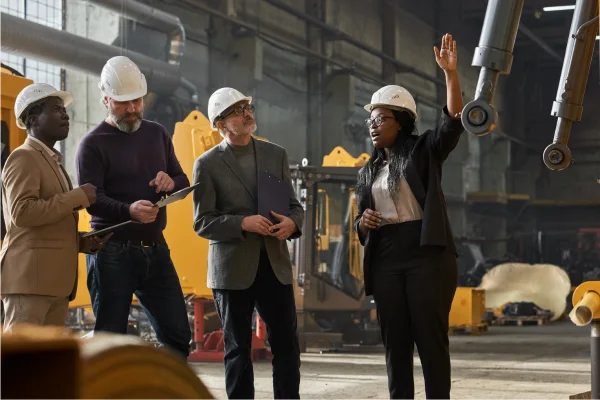
Welcoming visitors into an industrial facility means taking responsibility for people who may not know its processes, routes, or hazards. Visitor safety measures for industrial facilities must therefore begin before the tour and include access procedures, escorts, personal protective equipment (PPE), visible safety signs, and restricted-area controls.
Every visitor must also understand emergency instructions and wear visible identification. These measures help prevent incidents, strengthen occupational health practices, build confidence, and support compliance with industrial safety requirements.
Entry and escort procedures
The first step is to establish a clear procedure from the moment a visitor arrives. Every guest should register at the entrance, receive a short safety induction, and learn the facility’s basic rules. A badge or other visible identification helps distinguish visitors from regular personnel.
Visitors should remain with authorized personnel throughout the tour. The escort must explain approved routes, assembly points, and the instructions that apply to each area. The route should be clearly defined, and restricted or high-risk zones must be identified before the tour begins.
Some organizations use QR-coded badges or other access-control systems to record entry and improve traceability inside the facility. Technology can reinforce the procedure, but it does not replace induction or an authorized escort.

Personal protective equipment for visitors
PPE must be selected according to the hazards in each area. Common equipment for an industrial tour can include:
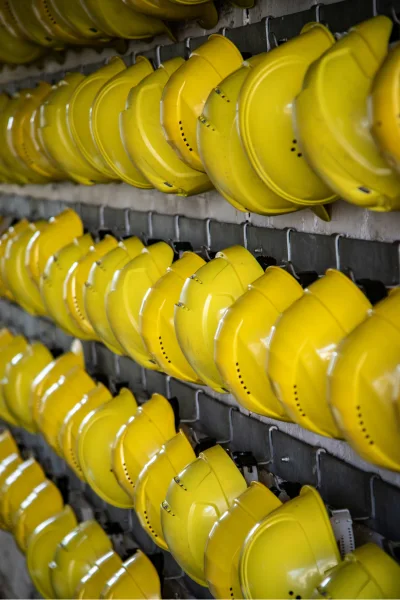
- Hard hat: helps protect against impacts and falling objects.
- High-visibility vest: makes visitors easier to see near vehicles or forklifts.
- Safety glasses: protect against airborne particles and certain projections.
- Hearing protection: is required in areas where noise levels demand it.
- Safety footwear: reduces the risk of impact or compression injuries.
A good practice is to maintain dedicated visitor PPE kits in several sizes. They should be clean, inspected, and accompanied by quick instructions. All equipment must reflect the identified hazards and the facility’s applicable requirements.
Clear and accessible safety signs
Safety signs help people identify hazards and required actions quickly. Industrial facilities commonly use:
- Warning or caution signs for potential hazards.
- Mandatory signs for actions such as wearing a hard hat, glasses, or hearing protection.
- Prohibition signs that restrict specific behaviors or access.
- Emergency signs that identify exits, evacuation routes, assembly points, and firefighting equipment.
In Mexico, NOM-026-STPS-2008 defines criteria for safety colors, signs, and hazard identification. Internationally, ISO 7010:2019 establishes registered safety signs for accident prevention, fire protection, hazard information, and emergency evacuation.
Signs must remain visible, unobstructed, and easy to distinguish from their surroundings. A safety map near the entrance, together with a short explanation, helps orient people who are unfamiliar with the facility.
Emergency preparation and restricted areas
Before entering, visitors must know how to respond to an alarm, which route to follow, and where the assembly points are located. Escorts should understand how to account for the people in their group during an evacuation.
Areas involving suspended loads, moving equipment, energized processes, or hazardous substances need specific controls. When entry is not essential, the safest measure is to keep visitors outside the area and provide an authorized observation point.
Benefits of implementing visitor safety measures
Visitor safety is more than an operating requirement: it is an investment in trust, compliance, and well-being. A consistent procedure helps prevent accidents, communicates professionalism, and reassures customers, suppliers, and business partners touring the facility.
Preparation also benefits internal personnel by standardizing responsibilities and revealing opportunities for improvement. Frequent and periodic crane inspections and crane operator training complement a prevention-focused culture around lifting equipment.
Sources
- International Organization for Standardization. ISO 7010:2019: Graphical symbols — Safety colours and safety signs — Registered safety signs.
- Occupational Safety and Health Administration. Materials Handling and Storage.
- Occupational Safety and Health Administration. Worker Safety Series: Warehousing.
- Mexican Ministry of Labor and Social Welfare. NOM-026-STPS-2008: Safety and hygiene colors and signs.